The Envision Framework is quickly becoming globally recognized as a highly credible approach and rating system for sustainable, resilient, and equitable infrastructure. It is a way to apply the principles of sustainability to infrastructure projects—bringing some structure to a typically amorphous topic. The framework is supported by the Envision Sustainability Professional (ENV SP) designation—an increasingly important credential for any professional involved in civil infrastructure. More than 8,000 professionals around the world have obtained their ENV SP credential since its inception in 2010! Becoming an ENV SP equips them with the knowledge to apply the ground-breaking Envision concepts to their daily work. In order to become an ISI Credentialed ENV SP, you must hold a four-year degree or have a Professional Engineer or equivalent designation. If you meet those basic requirements, you can apply. Because I still needed a few years of experience before I could sit for my PE Exam in 2020, I found then to be the perfect time for me to become an ENV SP!
I also wanted to become an ENV SP because this credential encourages community engagement and instills confidence that the project addresses community needs and concerns that I wanted to incorporate into my civil engineering projects. The Envision system also demonstrates that the sustainability achievements of the project are recognized and considered noteworthy by an independent international system.
Below I will step through the credential process as well as how to maintain your ENV SP credential. I personally earned my ENV SP credential in 2020 and have renewed my credential annually since then.
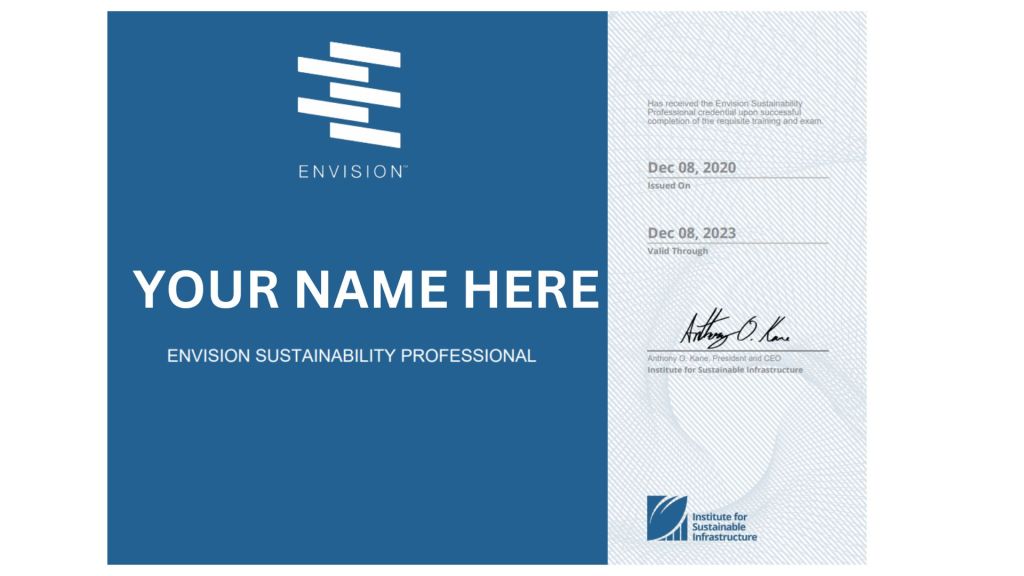
Sample ENV SP Certificate
ENV SP Training Course
The first step to becoming an Envision Sustainable Professional (ENV SP) is taking the ENV SP Training Course. This course is about 7 hours and can be taken online or as a full-day in-person workshop facilitated by ISI’s qualified trainers. Find a local future workshop at https://sustainableinfrastructure.org/credentialing/upcoming-workshops/. Completion of the course is a prerequisite for taking the ENV SP exam.
The course is divided into the following sections:
- Introduction to Envision
- Quality of Life
- Leadership
- Resource Allocation
- Natural World
- Climate and Resilience
- Applying Envision on Projects
The Envision Guidance Manual is the foundational component of the Envision framework. It contains 64 sustainability indicators, called credits, that cover the full dimensions of infrastructure sustainability. Credits are organized into five categories and 14 subcategories by subject matter. Each credit in the Envision Guidance Manual includes an intent statement and metric, levels of achievement, a description of the credit, ways to improve performance, evaluation criteria and documentation guidance, and related Envision credits. This course will walk you through the Envision Guidance Manual by each category.
Do not get discouraged if you don’t get all the Knowledge Check questions right as you go through the course! I know I got many of these wrong and I found most of these questions harder than any questions on the actual exam. While I did take notes throughout the course, I used the Envision Guidance Manual more than any of my notes when taking the exam.
ENV SP Exam
After completing the course, you must then pass a 75 multiple choice exam. This exam will take you about 2 to 3 hours to take. This is an open-book format using the Envision Guidance Manual. You have 6 months from when you are accepted into the program to take the test, though I recommend taking the exam soon after you complete the course.
The exam is pass/fail and you need at least 75% correct to pass. If I recall correctly, you also get three attempts before you need to pay to take the exam again and I passed on the first attempt. It is not a difficult test, but you really do need to know what you are looking for and where to find it in the manual to pass. Unlike the PE Exam, I did very little study other than taking the ENV SP Training Course to prepare. Before taking the exam, I highly recommend reading through the Envision Guidance Manual, primarily the introduction pages as well as skimming through each of the credits. The exam primarily tests you on how to best use and apply information from the Envision Guidance Manual, so being familiar with the material prior will make the test easier for you.
Maintaining your ENV SP Credential
Congrats – you have passed the multiple choice exam and now are a certified ENV SP! An ENV SP credential is valid for one year, and continuing education is required beyond that for ENV SPs to maintain their credential annually. Continuing education ensures that ENV SPs maintain knowledge of the latest sustainability practices and that they are well-versed on new approaches, innovations, and issues relevant to sustainable infrastructure. The credential maintenance period commences on the first anniversary of initially earning the ENV SP credential. Since I first earned my ENV SP in December 2020, my first credential maintenance period opened in 2021 and I had until December 2022 to complete my first credential maintenance. I am currently going through the annual credential maintenance as my ENV SP credential expires on Dec 8th, 2023 as shown in the photo of my ISI dashboard below.

The ENV SP credential will expire unless you participate in credential maintenance. The original credentials were designated with a three-year expiry period. With the implementation of the new credential maintenance program, ISI has shifted to an annual credential renewal. Now, the credentials have a 1-year expiry period and must be maintained annually in order to remain active.
To maintain the credential, ENV SPs complete two parts:
- Completing the required education hours, and
- Submitting the renewal fee.
Seven hours of education is currently required. Two of these seven hours are prescribed by ISI and the remaining five hours may consist of continuing education courses or other qualifying activities approved by ISI. Prescribed content and activities are intended to provide and reinforce must-know information and skills necessary to maintain an active ENV SP credential. Each year, ENV SPs complete 2 hours of qualifying prescribed work, and may choose from the following activities: Designated prescribed courses (on-demand or facilitated delivery by a qualified Envision Trainer), Project team work on projects that are active in the Envision verification process, Facilitating training that includes designated prescribed content.
To fulfill the remaining 5 education hours, ENV SPs may select from a range of activities to complete. Among the choices are additional ISI continuing education courses offered through the ISI website. Other activities that qualify for the fulfillment of the remaining 5 education hours include: ISI online on-demand continuing education courses, designated as elective, participating in additional ISI training (verifier, trainer, or project applicants) or premium courses, facilitating Envision workshops, verifying Envision projects, working on Envision projects, authoring articles on Envision and sustainable infrastructure, or volunteering on an ISI board, committee, or workgroup. Prescribed hours completed beyond 2 per reporting period may be counted toward fulfillment of elective hours. Education hours must be earned in the reporting period for which they are acknowledged. For example, my 7 hours for this year must be completed between Dec 2022 – Dec 2023. Any education hours earned above and beyond the 7-hour requirement will not be rolled over to subsequent reporting periods. Any elective education hours that are earned above and beyond the 5 hours allotted per reporting period will not replace or be used as a substitute for the 2 education hours required as ISI-prescribed courses. All 7 hours are to be completed, reported, and submitted by the last day of the reporting period. When the ENV SP has accrued enough education hours, they will “submit” their full report via their online credential maintenance portal found in their ISI account.
Similar to PDHs most if not all of the required education hours done asynchronously have a quiz associated with them. In my experience, this is typically a 10-question quiz where you need to get 7 correct to pass with multiple attempts.
The renewal fee is typically paid once you have completed your education hours, though you can pay this in advance. This is a fee of $50 if you are an individual member or a part of a member organization (My company is a member organization) or $80 if you are a non-member. Credential maintenance fees are waived for full-time students and faculty; however, students and faculty must fulfill the education requirements.
Any questions about taking the ENV SP Exam? Please send us an email at danitheengineer.blog@gmail.com or leave a comment below.
 STEM Changemaker
One Comment Add yours